
How to build a padel court foundation: concrete, asphalt & concrete-free.
The base decides the bounce, the lifespan, and a big slice of your budget. Here’s how to choose the right one, including the concrete-free option most investors don’t know exists.
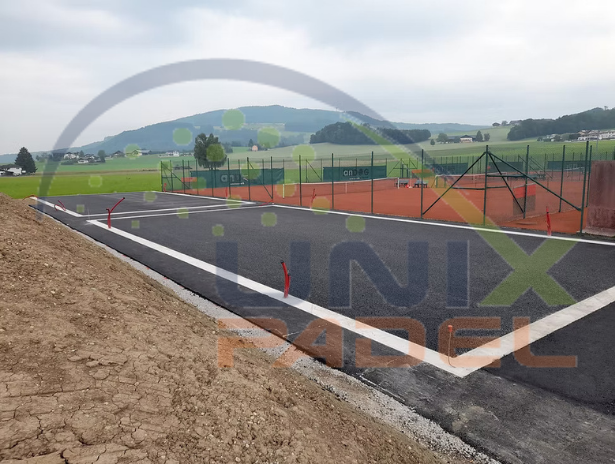
Every padel court stands on one decision: the foundation. Get it right and the structure, glass and turf perform for years. Get it wrong and you inherit dead bounce, standing water, drifting glass and cracks. For an operator, that’s not a technical detail. It’s the difference between a profitable court and a maintenance liability.
The foundation is not where you cut costs. It’s what protects every other euro, pound or dollar you invest.
The two zones of every slab
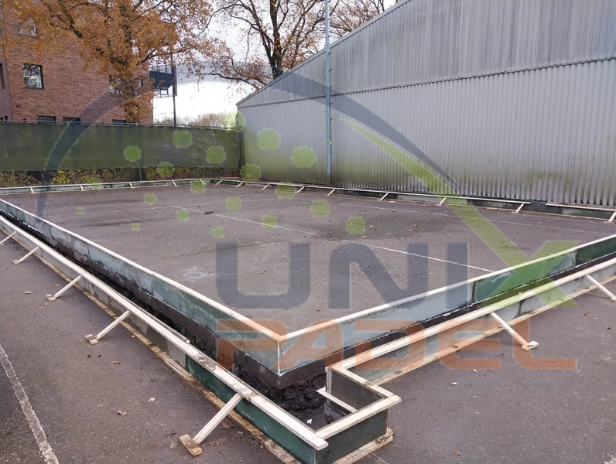
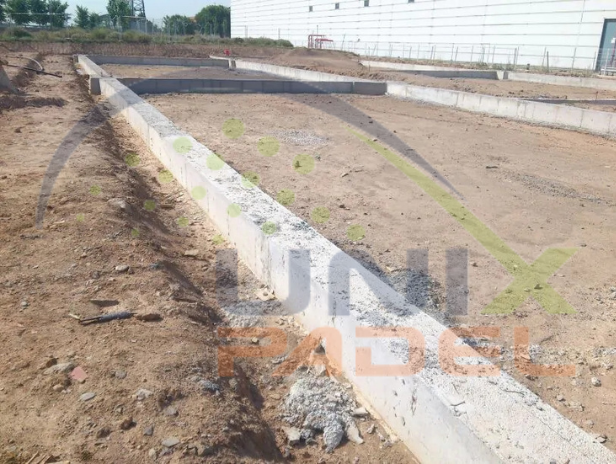
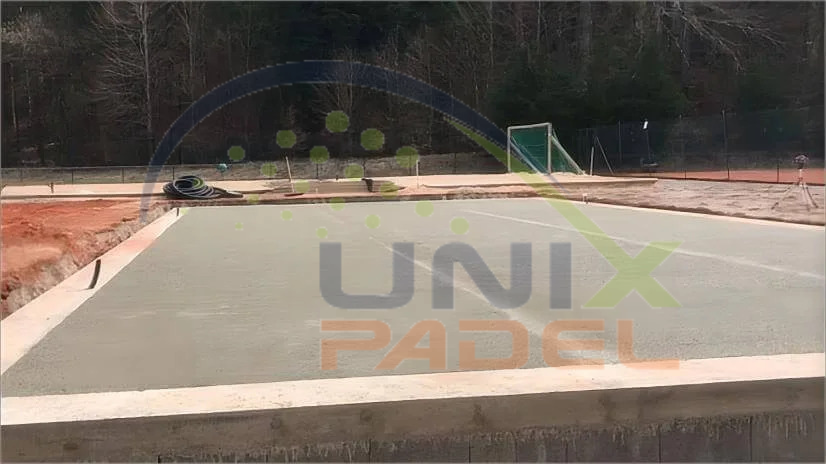
A padel slab is not one uniform pour. The perimeter, where the steel structure is anchored, must always be reinforced concrete (recommended 40 × 40 cm). The interior, under the turf, is where you choose your base: smooth concrete, porous concrete, or asphalt, or skip it entirely with a concrete-free system.
Concrete vs. asphalt vs. porous, at a glance
| Base | Cost | Drainage | Best for |
|---|---|---|---|
| Smooth concrete | Moderate | Needs a built-in slope (~1%) | Indoor courts |
| Porous concrete | Highest | Drains through itself | Premium outdoor |
| Asphalt | Lowest | Good (drainage asphalt) | Budget · cold climates |
Smooth concrete is the default for indoor courts. Porous concrete is the premium outdoor pick: rain drains straight through, the court is playable minutes after a downpour, and it’s gentler on players’ joints. Asphalt is cheapest but softens in heat and needs more upkeep.
The concrete-free option: Flat Floor courts
You don’t always need a concrete slab at all. The Unixpadel Flat Floor court is a patented, pedestal-based system that sits directly on any flat, stable surface (existing asphalt, paving, a rooftop deck or a compacted base) with no concrete base works required. The frame is hot-dip galvanized steel with an epoxy anti-rust coating, tested to wind speeds up to 120 km/h.
- Lower upfront costNo excavation, rebar or concrete pour. Site-prep spend drops sharply.
- Faster to revenueInstall in days, not weeks, and skip the 28-day concrete cure.
- Location flexibilityRooftops, car parks, event spaces, schools, resorts, historic centres and uneven sites all become viable.
- Relocatable assetThe court can be moved if a lease ends or footfall shifts, protecting your capital.
- Simpler permitsNo FIP concrete licence required, which streamlines approvals and setup.
- Ideal for leased landBuild on land you don’t own without a permanent slab tying you down.
The numbers that matter (for a concrete slab)
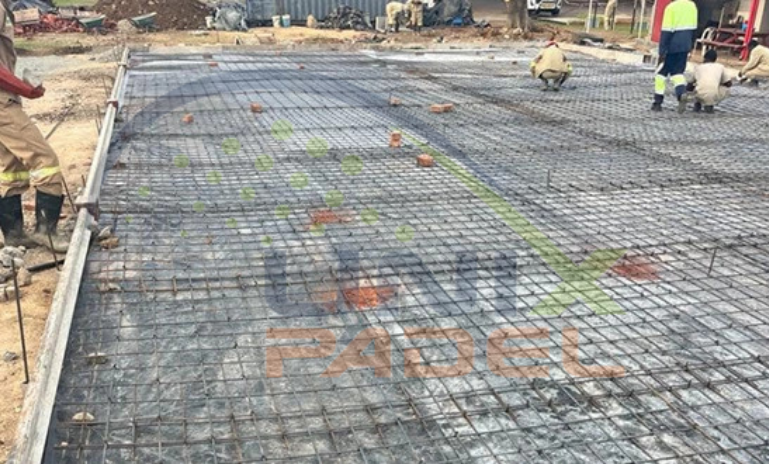
Add steel rebar mesh throughout to resist cracking, and remember the perimeter beam stays reinforced concrete whatever the interior base.
Regional guide: UK, USA & Germany
The “right” foundation depends heavily on climate and local codes. Simple slabs that work in southern Europe do not provide enough frost protection further north.
United Kingdom
Mild but wet, so drainage is the priority. SAPCA / LTA guidance points to a free-draining, non-frost-susceptible aggregate sub-base around 250 mm deep, topped with ~65 mm of porous asphalt in two layers. Building control approval required for enclosed indoor courts.
United States
One country, many climates. Florida demands hurricane-grade wind loads and high water tables; northern states need frost-protected footings; California requires seismic design. Baseline: a 6–8 inch (15–20 cm) reinforced slab at ~3,600 PSI.
Germany
Cold winters make frost protection non-negotiable. The frost line typically sits between 0.80–1.50 m, so foundations must reach frost-free depth with a gravel drainage layer beneath. Follow DIN standards and the Eurocodes, or sidestep heavy groundwork with Flat Floor.
Budget snapshot (2026)
Five mistakes that cost the most
Skipping the soil survey on outdoor sites: the slab ends up calculated on guesswork.
Under-compacting the sub-base: leads to settlement and cracks.
No drainage slope on smooth concrete: standing water destroys turf adhesives.
Exceeding flatness tolerances: ruins true ball bounce permanently.
Rushing the 28-day cure: weakens the entire structure.
Planning a padel court?
Whether it’s an engineered concrete slab or a concrete-free Flat Floor build, Unixpadel matches the foundation to your site, climate and business case.
Sources: Unixpadel · Flat Floor · LTA Guidance 2025 · SAPCA Code of Practice · NXPadel · The Perfect Slab · Reform Sports · Cost 2026