Short answer
A padel court stays safe and plays well with a simple routine: clear debris daily, brush the turf and redistribute the sand weekly, check glass, gaskets, mesh, net height and anchors monthly, and have the turf decompacted and topped up with sand every 6 to 12 months.
A padel court is used for hours every day, outdoors in all weathers or indoors under constant play. Small, regular checks keep the bounce consistent, prevent injuries and protect the investment. Most tasks take minutes and can be done by club staff; a few need a specialist once or twice a year.
What is the maintenance schedule for a padel court?
| Frequency | Task |
|---|---|
| Daily | Remove leaves, dust and debris; check doors and padding |
| Weekly | Brush the turf to spread the sand evenly and lift the fibres |
| Every two weeks | Clean the glass panels |
| Monthly | Check glass edges and gaskets, mesh panels, net height and tension, anchors and lighting |
| Every 6–12 months | Deep clean: decompaction, sand top-up, moss and weed treatment, seam inspection |
| Yearly | Full structural inspection and coating check; touch-up of any damage |

How do you look after the turf and sand?
Daily sweeping: leaves and organic matter block drainage and encourage moss, which makes the surface slippery.
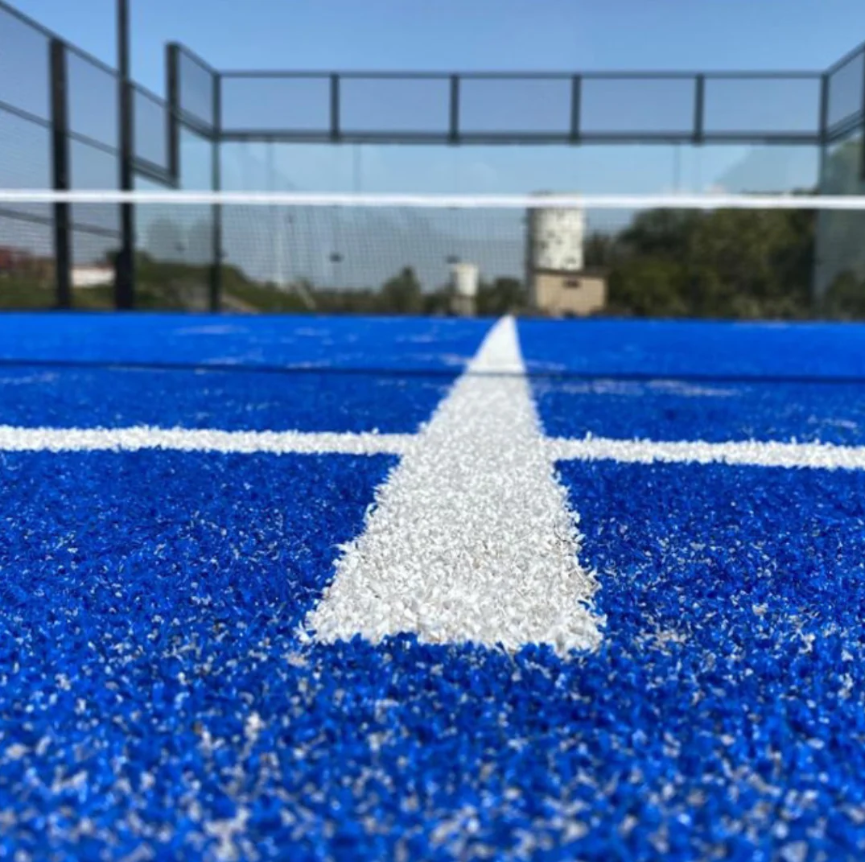
Weekly brushing: sand drifts towards the walls and the net during play. A wide, soft brush or a towed brush redistributes it so traction and bounce stay even and the fibres do not flatten.
Deep cleaning every 6 to 12 months:
- Decompaction: loosen compacted sand to restore cushioning and drainage.
- Sand top-up: replace sand lost to wind, rain and shoes, using the same rounded silica sand.
- Moss and weed treatment: apply a treatment suitable for artificial turf around the edges.
- Seam inspection: check glued joints and inlaid lines for lifting edges that could trip players.
How the choice of turf affects upkeep is explained in padel court surfaces.
How do you maintain glass, mesh and net?
Glass: clean every two weeks with a standard glass cleaner and a squeegee so players and spectators see clearly. Each month, check edges for chips and make sure the rubber gaskets between glass and steel are intact and the fixings are tight. Replace any damaged gasket straight away; glass must never touch steel.
Mesh and welds: look for loose panels, rattling fixings, damaged coating or rust spots. Sand down superficial rust, apply a zinc-rich primer and a matching topcoat. Broken welds need a professional repair.
Net: check that it is 0.88 m high at the centre and 0.92 m at the ends, that the cable tensioner holds, and that the headband is not torn. The full specification is in the net and mesh guide.
What should the structural check cover?
- Anchor bolts on the base plates, which can loosen over time.
- Plumb and alignment of columns, especially after storms.
- Coating condition on columns, beams and mesh frames.
- Door hinges, locks and padding on access openings and net posts.
- Floodlight fixings, aiming and cabling.
Seaside courts need more frequent rinsing and coating checks; see coastal padel courts.
When should you call a specialist?
Call in a specialist for cracked or chipped glass, broken welds, turf seams that keep lifting, standing water after rain, or an uneven bounce that brushing does not fix. Unixpadel’s technical team supplies replacement glass, mesh panels, turf, nets and accessories through repair and accessories and advises clubs worldwide. Contact our team with photos of the issue.