Short answer
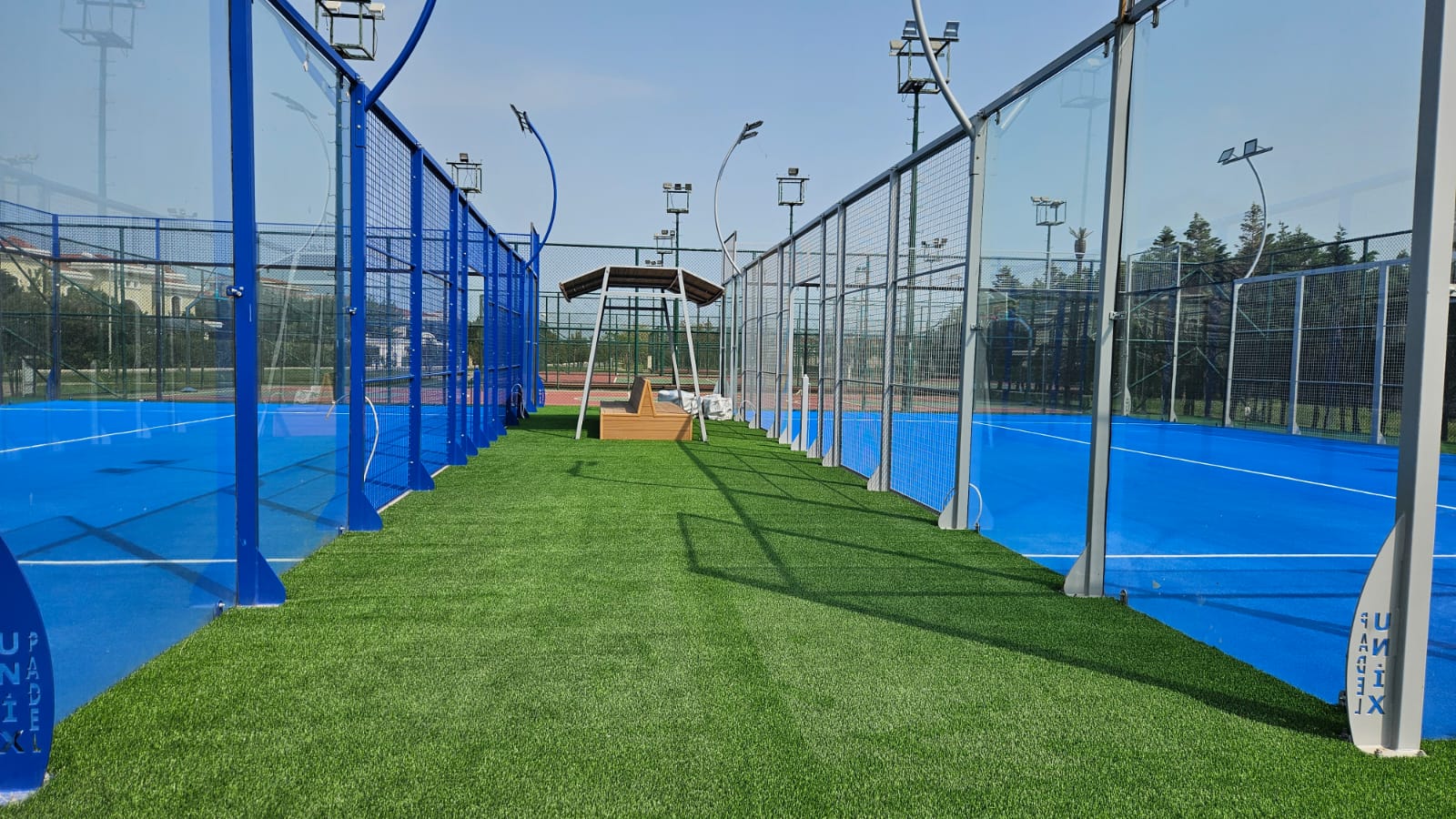
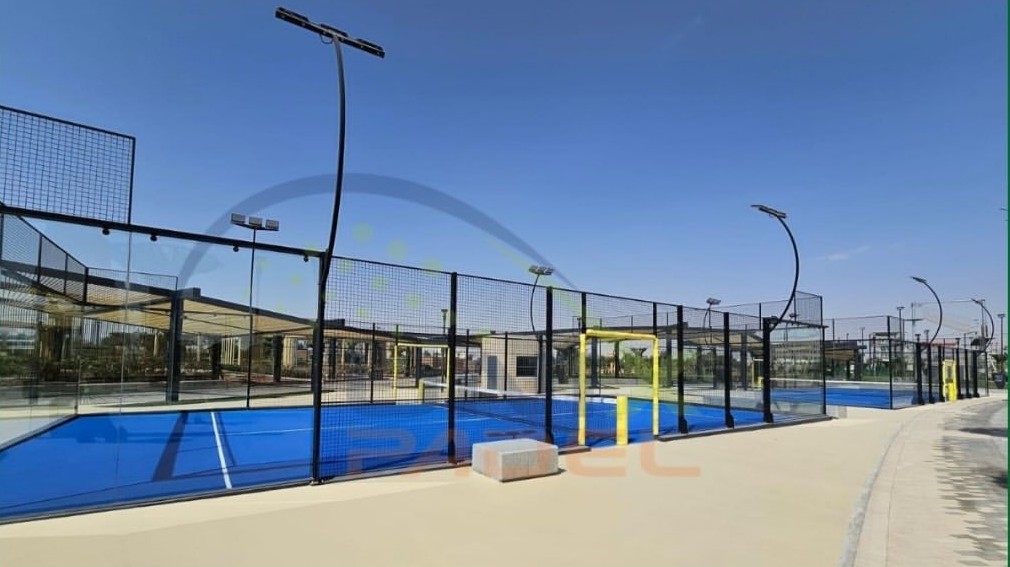
Building a padel court takes eight steps: feasibility and permits, layout and structural design, groundworks and a level base, anchoring the steel structure, fitting glass and mesh, laying the turf, installing lights and net, and a final inspection. With the base ready, a crew assembles a standard court in about 3 to 5 days.
Building a padel court is a well-defined process. Most delays come from the steps before the court arrives on site: permits, groundworks and drainage. This guide follows the sequence our installation teams use on projects around the world, so you know what to prepare and when.
1. Feasibility and permits
Confirm that the site can take the court and that you are allowed to build it:
- Space: a base of about 20.8 x 10.8 m per court, plus access, lighting posts and paths. See padel court dimensions.
- Ground and drainage: soil bearing capacity, existing services, where rainwater will go.
- Permits: lighting, noise and any canopy or building usually need local approval. Rules differ by country and municipality.
- Access for delivery: a truck with the court containers and space for unloading.
2. Layout and structural design
Choose the court model, orientation (north–south outdoors) and the position of doors, lights and paths. Ask for a static calculation for your wind zone; Unixpadel courts come with static analysis approved by Istanbul Technical University (ITU). The decisions behind this step are explained in the 5 key factors of padel court design.
3. Groundworks and base
The base is what keeps the court level and dry for decades, so it is not the place to save money.
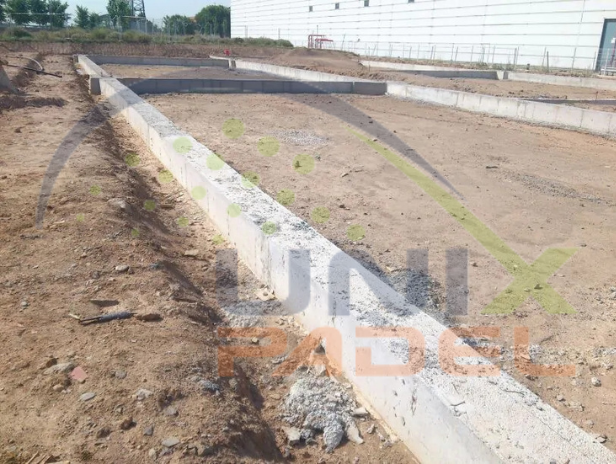
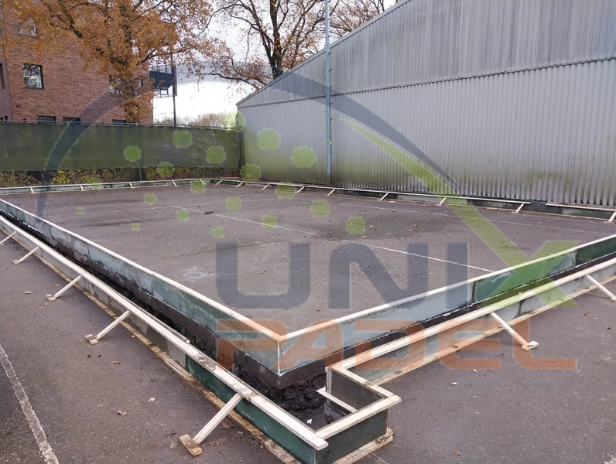
- Excavate and compact the ground, then cast a reinforced concrete perimeter beam (about 40 x 40 cm) that will carry the structure’s anchors.
- Build the interior base: smooth concrete with a 1% slope for drainage, porous concrete that drains through itself, or drainage asphalt on a budget.
- Check the level: the FIP allows no more than 3 mm of deviation under a 3 m straightedge.
- Let concrete cure for about 28 days before anchoring.
Our foundation guide compares the base options in detail. Where a slab is not possible, the Flat Floor court sits on pedestals over any flat, stable surface and skips this step.
4. Steel structure
Installers set out the court on the slab, place the hot-dip galvanized, powder-coated columns and beams, and fix the base plates to the perimeter beam with heavy-duty expansion anchors. Every column is checked for alignment and plumb before the walls go in, because the glass needs a true frame.
5. Glass, mesh and doors
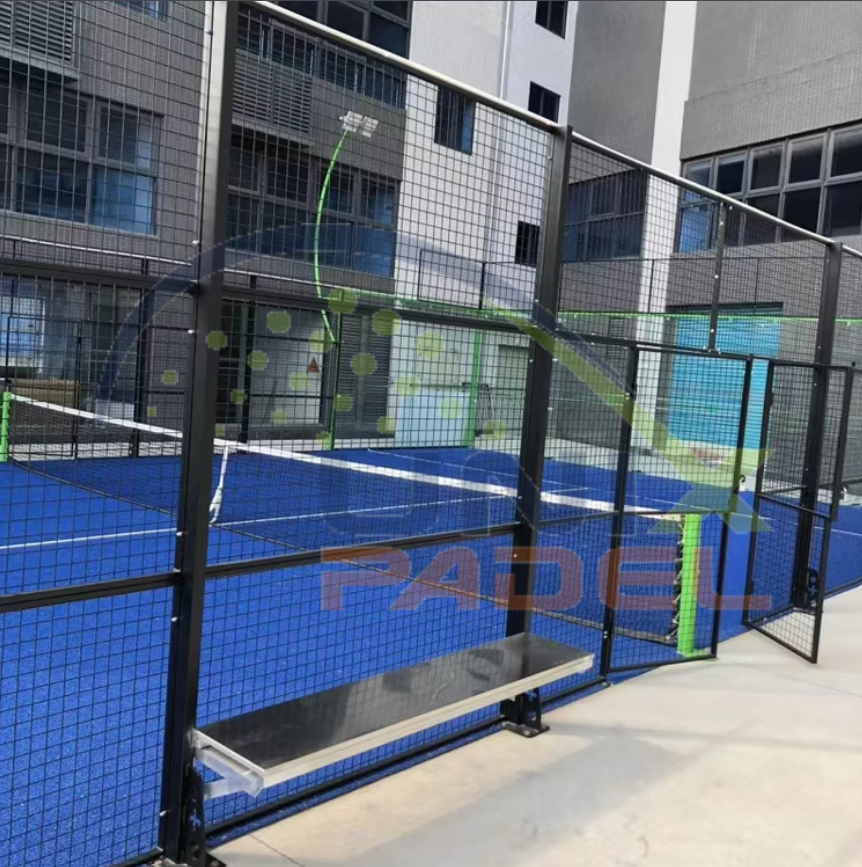
Tempered safety glass panels (10 mm on standard courts, 12 mm on panoramic courts, to EN 12150-1) are lifted into place and fixed with rubber gaskets so glass never touches steel. Electro-welded mesh panels close the rest of the enclosure, flush with the inner face of the glass, and the doors and access openings are fitted. Quality checks for this step are in the net and mesh guide.
6. Artificial turf and lines
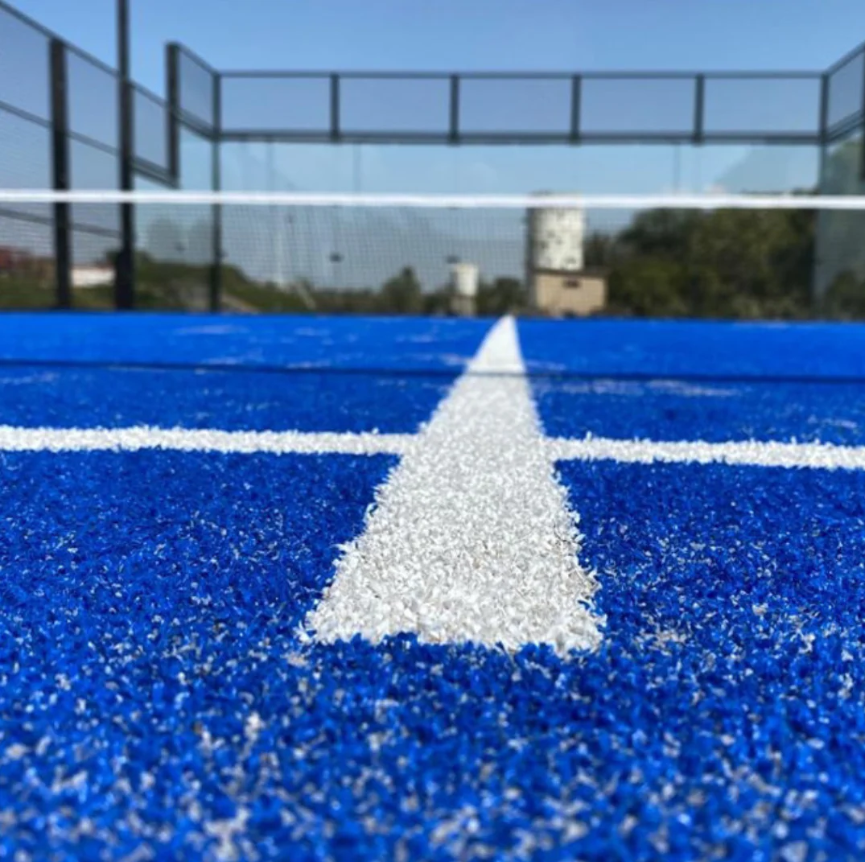
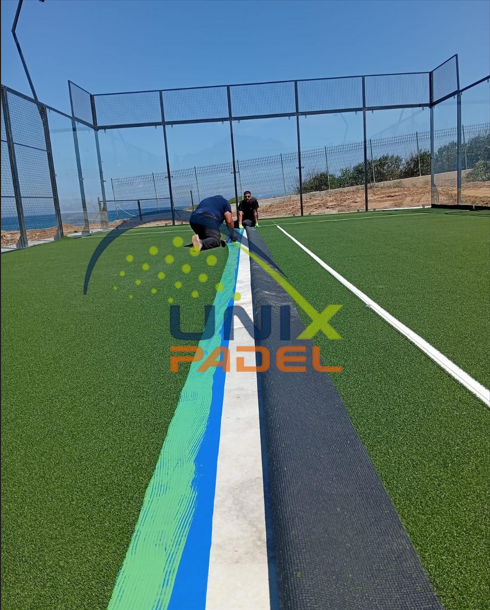
The turf rolls are laid, seams are joined, and the 5 cm lines are inlaid in white or black. The turf is then filled with rounded silica sand and brushed in evenly. The choice of turf is covered in padel court surfaces.
7. Lighting and net
LED floodlights are mounted outside the playing area with the bottom of the fittings at least 6 m above the floor, wired and aimed for even light without glare on the glass. The net is hung and tensioned to 0.88 m at the centre and 0.92 m at the ends.
8. Inspection and handover
Before the first booking, the team checks level, anchor torque, glass gaskets, door operation, net height and lighting. The operator receives a maintenance plan; see padel court maintenance.
How long does each step take?
| Step | Typical duration |
|---|---|
| Feasibility, design and permits | 2–8 weeks, depending on local approvals |
| Manufacturing at the factory | Depends on model and order size |
| Groundworks and concrete base | 1–3 weeks plus about 28 days of curing |
| Court assembly (structure, glass, mesh, turf, lights) | About 3–5 days per court |
Who builds it?
Unixpadel manufactures every court in its own factory in Adıyaman, Türkiye, and its installation teams assemble courts worldwide or supervise local contractors. The budget for the whole project is explained in how much a padel court costs. Ready to plan your build? Send us your site details.